Tag Archives: gallery

Turning the Tide

"The United States of Consumerism" by Amy Guidry; acrylic on canvas; 30"w x 24"h; Private Collection; (c) Amy Guidry 2012

First, I should apologize for my absence last week.  I have lots going on and much to share, which I will be doing over the week so be on the lookout.  As some of you may know, last week the arts community of Louisiana received some sad news- legislators approved a 1/3 cut in Decentralized Arts Funding (DAF) and Statewide Art Grants (SAG).  This affects an estimated 148,000 jobs, Louisiana’s tourism industry, as well as artists, teachers, museums, libraries, theaters, art centers, festivals, among others.  The news is grim, especially given the fact the Arts tend to be the first that are cut and already do not receive enough funding.  I personally know of small museums and art centers that have been struggling to get any kind of funding and risk closing.

So what can we do?

The most obvious answer deals with how we vote and voicing our opinion to local and national politicians.  Thanks to the internet and groups such as Louisiana Citizens for the Arts, you can stay up to date on these issues and contact the appropriate individuals with the click of a button.  And don’t worry about writing the most profound letter, either.  My thoughts are as long as you are writing something, even if it’s just to send the form letter already provided, it will make a difference.  All correspondence adds up.

That being said, politicians need to see numbers.  Letters and phone calls are great, but it also boils down to whether the public is willing to put their money where their mouth is.  You say you love art, but do you really?  They need to see the numbers.  Numbers being the tourism dollars, the tax revenue, the number of people attending arts events, and so on.  If you want to prove that these artists and organizations matter, as well as support them along the way, you need to do the following:

Buy art— Seriously.  This is not some propaganda I’m passing along because I’m an artist.  If you buy art you’ll support artists, galleries, museums, and art centers so they can continue to thrive in your community rather than closing down or moving somewhere else where they appreciate art.  In turn, those sales taxes and income taxes from art speak highly in the eyes of the government.  Funding goes to those that make money and are a good investment.

Attend events— Support your local arts community by attending performances, exhibit openings, lectures, and so forth.  You’ll have an entertaining evening and know you’re making a difference in the process.  Even if it’s a free event, you’re still helping because those numbers matter.

Sign the guestbook— So many people attend an event and pass by the guestbook without signing.  Maybe you don’t think it’s important or you are weary to share your information.  Whatever the case may be, you need to sign the guestbook.  Those names translate to numbers.  Museums and art centers report those numbers in order to prove their importance and receive funding.  No one wants to support a museum if they have no visitors.  So sign your name- you don’t have to give any other information unless you want to- as long as there is a name, it adds to the numbers.

Become a member— Aside from government funding, these organizations receive funds from, well, you!  Paying for an event is great, but if you really want to help, become a member.  You can join any or all, and there are various levels for joining most groups.  Many museums and art centers offer general membership at reasonable rates, some offer rates for students and seniors, so check their websites.

How do you support the Arts?  Feel free to add ideas in the comments section.

————

www.AmyGuidry.com

Sign up for my monthly newsletter at: www.amyguidry.com/contact.html

Follow me on Facebook: www.facebook.com/pages/Amy-Guidry/51953219932

One

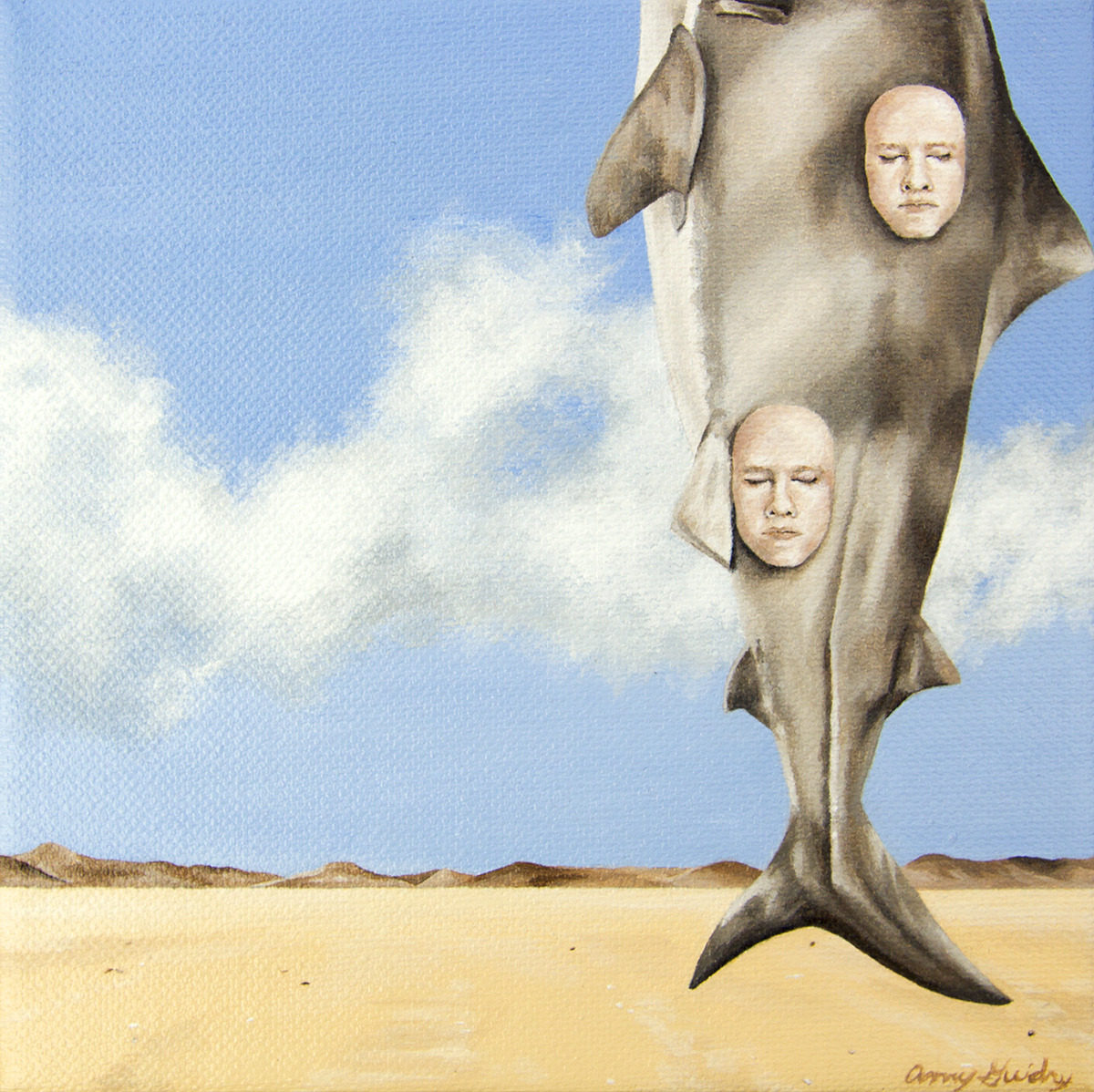
“One” by Amy Guidry; acrylic on canvas; 6″x 6″; SOLD; (c) Amy Guidry 2012

Finally finished!  I’ve just completed my painting for The Great West Coast Migration traveling exhibition.  The title is One and it is an acrylic on canvas, 6″ x 6.”  The exhibition is organized by PangeaSeed and will benefit sharks and oceans in Japan and abroad.  Given that so many sharks are killed for their fins (a delicacy in Japan and China), this cause was of particular interest to me not only as an artist but as a vegan as well.  People often think of sharks as vicious predators, (thanks, Media!) when in fact, they do not seek out humans and only a small percentage of shark attacks occur each year.  I wanted to focus on them as being part of this world and just as significant as the rest of us.  I combined the human faces with the shark body to illustrate them as one, or equals.  The shark body floats in the air, in keeping with many of my other paintings, but also mimicking the hunted, hanging sharks I so often see.  Such a simple title- One– and such a simple concept, yet we still struggle to see our planet as something to share rather than dominate.

The exhibition will begin this summer at the following galleries:

Seattle – Roq la Rue Gallery- July 13-15
Portland – Grass Hut Co.- July 20-22
San Francisco – Spoke Art Gallery- July 27-28
Los Angeles – LeBasse Project- August 2-4
Costa Mesa – The Artery- August 10-12
San Diego – Space 4 Art- August 17-19

————

www.AmyGuidry.com

Sign up for my monthly newsletter at: www.amyguidry.com/contact.html

Follow me on Facebook: www.facebook.com/pages/Amy-Guidry/51953219932
Eye of the Beholder

Eye of the Beholder 2012

For a change of pace, I will serve as the juror for the upcoming LAA “Eye of the Beholder” exhibition in Lafayette, LA.  I was honored to be asked and more than happy to be this year’s juror.  I’m excited to see the work that is submitted, especially as I am sure to see work by new artists and those that are just new to me, in addition to new work by artists that are fixtures in the art community here.  The competition is regional and open to anyone in from Texas to Florida.  Submission dates are May 16- 25, which is right around the corner, so get your entries in soon.  Also, it is an open themed show, so don’t get too caught up in the exhibit title.  More information can be found on the Lafayette Art Association website at this link: http://lafayetteart.org/wp/2012/05/eye-of-the-beholder-xxvi-submit-may-16-25/

————

www.AmyGuidry.com

Sign up for my monthly newsletter at: www.amyguidry.com/contact.html

Follow me on Facebook: www.facebook.com/pages/Amy-Guidry/51953219932

Love & Sharks

Design by PangeaSeed Creative Director - Aaron Glasson (Rah Akaishi)

I have recently been invited to participate in The Great West Coast Migration, a touring art exhibition, organized by PangeaSeed in an effort to benefit sharks and oceans in Japan and beyond.  According to PangeaSeed, “We are very excited to showcase a robust fund-raising art collection featuring works contributed by more than 100 internationally renowned artists, graphic designers, filmmakers and photographers. Almost all of our globally-based artist friends will be premiering their works for the first time ever in the United States. Also a percentage of the proceeds from the summer exhibitions will also help in aiding the startup of PangeaSeed’s inaugural west coast chapter whose mission and efforts will help further fundraising to keep sharks afloat on the west coast and around the world.”

The exhibition tour will take place at the following:

Seattle – Roq la Rue Gallery- July 13-15
Portland – Grass Hut Co.- July 20-22
San Francisco – Spoke Art Gallery- July 27-28
Los Angeles – LeBasse Project- August 2-4
Costa Mesa – The Artery- August 10-12
San Diego – Space 4 Art- August 17-19

Participating artists include: Dave Kinsey, Mike Stilkey, Brad Klausen, Yoram Benz, Skinner, Gale Hart, Shark Toof, Bwana Spoons, Craig Tapecat McCudden, Bigfoot, Danny Miller, Rah Akaishi, Justin Lovato, Lindsey Carr, Serge Gay Jr., Brett Amory, Robert Bowen, Ryan Maguire, MCA, Mario Wagner, John Fellows, Ronzo, Sylvia Ji, Toshikazu Nozaka, Michael Alm, Lindsey Way, Remo Camerota,  Cometdebris (Koji Harmon), Gargamel, Blunt Graffix (Matt Dye), Samuel Rodriguez, Aaron De La Cruz, Ben Tour, Linnea Strid, Crajes, Becky and Louise, Max Dalton, Olek, Caitlin Hackett, Derek Nobbs, Jeni Yang, Scott Belcastro, Yoh Nagao, Joshua Petker, Flick Ford,  Lisa Congdon, Josie Morway, Luciano Scherer, Scott Hove, Tati Suarez, Tugboat Printers, Victor Castillo, Peap Tarr, Meg Adamson, SHERYO, Aidan Monahan, The Yok, Spencer Keeton Cunningham, Cinzah Merkins, Nao Harada, Sage Vaughn, Adam Wallacavage, Erik Otto, Mr. Jango, P Williams, Morgan Slade, Jasper Wong, Flavien Demarigny, Laura Ball, Courtney Mattison, La Pandilla, Sam Rulz, Casey Grey, Greg Simkins, Jim Phillips, Nathan Spoor, Kid Creature,  Ransom and Mitchell, Cupco (Luke Temby), Kelly Allen, Sean Tuttle, Amy Guidry, Kozyndan, Rhys Cooper, John Stuart Berger, Bruce Gossett, Sandra Cappelletti, Michael King, Carbon, Kim Scott, Ashley Suzanne Taylor, Mika Tenekoon, Pascal Lecocq, APAK, Asher Jay, Trip Airways, Kaoru Sakai, Jim Mazza, Winnie McDonald, Rob Mack, Jeremy Pruitt, Rick Rietveld, Ben Brough, Caspian de Looze, Nathan Paul Gibbs, Thaddeus Strode, Paul Kaiju, Le Merde, Vexta, Kool Kid Kreyola, Foerdl Scheichenost

I’ll be posting my finished piece for the exhibit here (and the links below) so be on the lookout.

————

www.AmyGuidry.com

Sign up for my monthly newsletter at: www.amyguidry.com/contact.html

Follow me on Facebook: www.facebook.com/pages/Amy-Guidry/51953219932

Field of Dreams

Artist Amy Guidry with her work at the Slidell Cultural Center at City Hall

I decided to re-post this since it was a popular post I had done awhile back. So for those of you that are new or may have missed this, I hope you find it inspiring!

No one cares about your art more than you do. It’s true. It’s not unlike showing your vacation photos to everyone. They mean well, but after about two minutes, the enthusiasm wears off and their eyes glaze over. I was inspired to write this after going through some old art magazines to clear out the mountain of periodicals I’ve saved. I came across a rather disheartening article in a very popular magazine. The author was giving advice on how to be a successful artist. Some of the author’s tips? Paint what sells- not more “complex” paintings, don’t bother showing in libraries or university galleries since they don’t generate sales (museums usually don’t either, but I don’t know an artist alive that wouldn’t jump at the chance to show in a museum), and sell on Ebay- specifically bright, colorful, quick paintings- no drawings. I know better than this and even I found it depressing! I can only imagine what other artists must think.

So this is what leads me to my frustration. I don’t care who they are or if they mean well, no one truly cares about your art or your art career as much as you do. This is why you are the only one that can determine what your goals are and if, at the end of the day, you’ve done all that you can to achieve those goals. Don’t listen to the naysayers, the haters, the critics, the cynics, or the non-believers. What do they know anyway? Even some of the experts can’t always predict what you, personally, need to do. That’s why it’s up to you to take in all this information and filter through it and find what is applicable and toss away what’s not. You know what you need to do. You know if your work is the best it can be. You know what you should create. If you try to “paint what sells,” you’ll be chasing your tail for quite some time. Popularity changes as do marketing trends. Something that sells one day, won’t the next. That’s why there are trend analysts that make a living at this. Great work is great work and it will attract its own popularity. And while I’m at it- if you were to avoid university galleries, libraries, museums, or any other venue for fear of little to no sales, you wouldn’t be an artist, would you? I couldn’t imagine not having the experience of seeing art, especially when I was a student, at a university gallery or museum. Some of the most significant shows of our time come from these venues.

In my own personal experience, I’ve heard it all. I’ve been told what I should paint, how I should paint, and I’ve even had a drunk non-artist tell me what is and isn’t art. When I made the decision to paint and to try to get into a gallery exhibit, even one of my “good” friends told me that I couldn’t do it. It’s a good thing I didn’t listen to any of these people, otherwise I may not have even been an artist at all. Anyone listening to that kind of advice would quit before even starting. Don’t make that mistake. If you’re already a working artist, just keep on trucking. If you’re just starting out, stay focused and put your blinders on. And maybe invest in some good ear plugs.

Being a true artist takes grit. There’s a lot of blood, sweat, and tears, and you’ll need to develop a thick skin. However, I can’t imagine a more rewarding experience. I always like to think of these words by Ralph Waldo Emerson: “Nothing great was ever achieved without enthusiasm.”

————

www.AmyGuidry.com

Sign up for my monthly newsletter at: www.amyguidry.com/contact.html

Follow me on Facebook: www.facebook.com/pages/Amy-Guidry/51953219932

What It Takes

I wanted to take a moment to discuss some concerns that I hear repeatedly amongst artist friends and online.  If you are reading this post, then more than likely you are an artist or maybe an art enthusiast.  Some of you may have embarked upon making a career of your art while others are afraid to do so for various reasons.  And of the ones that are currently working on their art careers, you may find yourselves discouraged at times or frustrated that things are not going as planned.  So what do you do about it?  Well, I am here to say that first of all, don’t give up.  And don’t be scared, or discouraged, or angry, or sad, or frustrated, etc., etc., etc.  This is a subjective business and not everyone will feel that your work suits their gallery or their living rooms.  And that’s okay.

Let’s face it.  This career is not for sissies.  But if you love your art, which I’m sure you do, then the other stuff won’t really matter.  Take pride in your work and take pride in all that you have accomplished.  Even if you’re just starting out, you have a lot to be proud of just in taking the first step to starting your career.  Shockingly enough, most people do not take those first steps (and that’s including those that are not even artists).  It takes guts to make the first move.  You’re getting out of your comfort zone.  And even once you are well into your career, you will find that you still have to shake things up and get out of your comfort zone again and again.  As the stakes get higher, you need to do more as well as reach more.  But that’s okay because you love what you do.

Aside from loving your work, you have to be consistent.  That is the one thing that I see so many artists drop the ball on.  Consistency is key.  You can’t expect to accomplish everything overnight.  You will have to slowly build and take each step towards building your exhibition experience, your portfolio, your sales, your awards, etc.  And just because you accomplish one goal, doesn’t mean you can stop.  You have to keep on plugging away at your career.  You can’t just coast or rest on your laurels.  You’ll need to have new work to show, you’ll need to expand to other cities, other states, other countries even.  You’ll need to keep moving.  How many bands can you think of that were one-hit wonders?  How many actors can you think of that were popular and then seemed to disappear from the face of the Earth?  You may find it hard to even think of examples but once you do, you’ll be thinking, “oh yeah… whatever happened to…?”  Don’t be one of those cases.  You are not a flash in the pan.  You’re serious about your career and you are here to stay.

The good news is it’s not about luck!  Sure, sometimes you may happen to be in the right place at the right time, but that won’t be often.  And even if it does happen, it won’t necessarily make your career.  Even for the positive things that happen in your career, if it wasn’t directly related to your doing, if you trace it back, you will probably find that it was thanks to one of the “seeds” you planted in the first place.  You don’t need to buy a Magic 8 ball or get a tarot reading.  Just keep putting yourself out there, creating more, improving as much as possible, marketing, networking, exhibiting, etc.  You don’t need luck- luck is hard to get anyway.  Consistency is easy enough to do and is a sure bet.

Stay strong, be consistent, and be professional.  The rest will follow.

————

www.AmyGuidry.com

Sign up for my monthly newsletter at: www.amyguidry.com/contact.html

Follow me on Facebook: www.facebook.com/pages/Amy-Guidry/51953219932

New Acquisition

"Everything's Coming Up Roses" by Amy Guidry; acrylic on canvas; 40"w x 30"h; (c) Amy Guidry 2007; Permanent collection of The City of Slidell

I’m excited to announce that my painting Everything’s Coming Up Roses is now in the permanent collection of The City of Slidell.  It is an acrylic on canvas, 40″ wide by 30″ high, and from my Beneath the Surface series from 2006-2007.  It will be located at City Hall in Slidell, Louisiana (just outside of New Orleans), which is my original hometown.  I am honored to have a piece in their collection and am in great company as they also have work by George Rodrigue, Barbara Shaw, and George Dunbar, among others.  View the painting (as well as zoom in) at this direct link: www.amyguidry.com/everythings_roses.html.

————

www.AmyGuidry.com

Sign up for my monthly newsletter at: www.amyguidry.com/contact.html

Follow me on Facebook: www.facebook.com/pages/Amy-Guidry/51953219932

Signing the Dotted Line

A recent online discussion regarding gallery contracts reminded me that this is something I should have posted awhile back.  There are surprisingly a lot of artists that avoid showing with galleries for fear of the contract.  In actuality, the contract is what keeps you protected and prevents anyone from running off with your money.  In fact, if there is a gallery you are interested in working with that does not “do contracts,” you should either make your own for them to sign or else leave.  It’s wise for both parties to have a legally binding document that ensures that everyone involved is covered.  Art is money, so when you’re handing over your work to a gallery, you’re essentially handing them hundreds to thousands of dollars and hoping they’ll take care of it for you.  With that said, here is a list of most (I may be forgetting some things…) of the issues that should be covered in your contract.  Most of these pertain to a gallery that is representing you, but much of this applies to short-term gallery exhibitions as well.

Commission: The standard here is 50/50, but can vary depending on your location.  This absolutely must be covered in any contract with any gallery, no matter if they represent you or not since this is what determines exactly how much you receive from the sale of your work.  And on a side note, it is perfectly fair for a gallery to get half of the sale since they are the ones that have to pay for your exhibition, advertising, rent and utilities for the building, catering, etc.  If a gallery isn’t doing this for you, then they are not earning their share, which in that case, I would recommend going elsewhere.

Payment: Another must.  When will payment be made?  Some galleries may wait until the end of an exhibit to send you your check, while others may pay you immediately.  Sometimes this is determined by how the customer paid, especially if they are on an installment plan.  Usually to cover all bases, contracts will state that payment is made within 30 days from the end of an exhibition.  Just so long as it clearly states that you are going to get paid within a reasonable period of time, then it should be fine.

Insurance: This is another must in my book, however, I have seen some great spaces not offer insurance, so I can’t say that I haven’t taken a risk at times myself.  However, you should be seeking out galleries that provide insurance while your work is on their premises, especially if they are representing you.  If your work is there long-term, odds are greater that something may happen- fire, theft, etc.  You can look into getting your own insurance coverage, but it won’t be cheap, so you may be better off leaving it up to the gallery.

Framing: Frames are not generally required for all artwork, but this should be laid out in the contract.  If frames are required, it needs to be clearly stated who covers this cost and what type of work- drawings, paintings, printmaking, etc. or just certain types of work?

Discounts: It is not uncommon for a gallery to offer discounts to their regulars or for a purchase of multiples.  This practice is normally only done in representing galleries as they are the ones with a particular roster of artists that they deal with on a regular basis.  Discounts can range from 10 to 20%.  The contract should clearly cover what the discount is or what the range may be and how it is divided- evenly between the gallery and artist or does the gallery take that out of their cut entirely?

Shipping: For those that are out of the area or state, shipping costs need to be covered as this can be very costly.  Shipping policies vary among galleries, so I can’t say that there really is a standard here other than that if it is a short-term exhibition in a non-representing gallery, typically the artist pays for shipping their work to and from the gallery.  For a representing gallery, the artist may be responsible for to and from shipping, or only shipping the work to the gallery, or the gallery may cover all shipping costs.  As far as shipping the work to a client, the gallery will either pay or the client will, not the artist.

Outside Sales: This could be a post in and of itself given the discussions with other artists.  The gallery that you work with may allow you to sell work on your own through festivals, studio, etc. and I have yet to see a gallery that doesn’t.  First, be sure that your work is priced consistently with that of the gallery.  Typically if a sale is made to a client from the gallery, then the gallery will get a commission, usually their standard rate.  However, if the client is someone not affiliated with the gallery and did not see your work via the gallery, then the gallery may only require 20 or 30% or often times, there is no commission.  Point being, if you had to do all the leg-work to get that client, then you would get the entire amount of the sale, but again, that would apply to people unaware of the gallery.  This should be covered in your contract, including the commission rate, if any.

Exclusivity: Typically galleries only require exclusivity to the city they are in.  However, some require exclusivity to the region, state, and even the entire nation (though these are generally “blue-chip” galleries dealing with work that goes for hundreds of thousands to millions of dollars).  Again, this is another issue that should be clearly spelled out in your contract.

Loaning Work: This is usually only an issue for those represented by more than one gallery or those that enter work to juried shows in which the same work is already in a gallery.  If work needs to go from one show to another, the gallery that currently represents that work may require a commission if that work sells in another gallery.  Both galleries would get a commission, for example, each gallery may get 30% while the artist gets 40%.  This rate varies among galleries, though, and should be clearly stated.

Length of Contract: Most contracts remain active so long as the artist is with the gallery.  Generally there is an “out” for each party with a 30-days prior notice, again, this may vary, but 30 days is usually all that is required.  In the event that the relationship is not working, either party has the option to end it.

Exhibitions: This only pertains to representing galleries in which your work is there long-term.  What type of exhibitions will the gallery guarantee and how often?  Will you have the opportunity to have a solo exhibition and will you also be given group exhibition opportunities?  Where will your work be when it’s not being exhibited- typically galleries have a salon in which a mix of works by the gallery’s artists are featured in the back room or even in their project space.

Most importantly, take your time and look over your contract before signing.  There’s nothing wrong with asking to have a day or two to look it over.  You could even run it by someone you trust just to make sure there’s nothing you’re missing.  As I said, if a gallery doesn’t have a contract, tell them you would like to make your own and be sure to cover all of these aspects mentioned.  If you’re uncomfortable telling a gallery you want to make a contract, just put it in benign terms such as that it’s how you keep track of things, or that you might forget (not that you want to appear stupid to these people but put it off on yourself if you need a cover).  If you feel any amendments need to be made, write it up and send a proposal to the gallery.  More than likely they will oblige and add it to your contract.  Above all else, if you are not comfortable with the arrangements, do not sign and look somewhere else.  There are plenty of other fish in the sea.

———-

www.AmyGuidry.com

Sign up for my monthly newsletter at: www.amyguidry.com/contact.html

Follow me on Facebook: www.facebook.com/pages/Amy-Guidry/51953219932

Marketing vs. Studio Time

Since we are in the midst of the holiday season and there never seems to be enough time in the day, I was inspired to write about a popular question… How much of your time should you spend in the studio and how much should you spend marketing?  I’ve heard everything from spend most of your time creating to spend 80% of your time marketing.  I can’t say that any one answer is the correct one, however I personally lean towards the marketing end these days.  Unless you are a true beginner with a handful of work to your name, you should be marketing your work.  Sure, if you don’t have work to show, you can’t have an exhibit.  However, you won’t get any exhibits if you’re not marketing your work.  And it’s not just shows you will earn, but publicity on the internet, magazines, tv, radio, etc.  So back to the big question- just how much and how do you balance it all?

-It’s best to do a little each day (as far as marketing goes) but if you are the type that won’t be consistent, it would be better to do your marketing all in one day (or 2…) than not at all.

Gauge your deadlines.  If you have a show scheduled, clearly you will need to devote a lot of studio time.  Figure out roughly how long it will take you to do the desired amount of work and plan your schedule accordingly.  Any remaining time should be spent marketing, especially when you have a show to promote to collectors, the media, etc.

Set limits.  It’s easy to lose track of time if you’re buried in paperwork, doing research, or networking via social media.  Set a reasonable time limit for each task and stick to it.

-Prioritize your marketing goals.  There are a ton of things you can be doing to promote your work, so much so it’s overwhelming.  But you won’t be doing all of these things everyday, nor do you really need to.  Decide what is most important and allot a day or days to accomplish those goals.  For instance, how many times a week do you want to post on your blog?  Pick the days of the week you wish to do so and keep the remaining time free for other marketing efforts throughout the week.

-Marketing is especially important when you have something to crow about.  If you go pretty light on marketing, then you should at least devote more time to it when you have a big announcement.  If you have a show coming up, won an award or grant, did a big interview, were on tv, spent time in Paris painting for the summer, etc., etc. then you need to up your marketing efforts to announce these accomplishments to your local media as well as your mailing list, email list, etc.  These are the things that people want to read about.

-It takes a village (well, sort of…).  We rely on galleries, collectors, reporters, etc. to talk about us and get our work “out there.”  It’s great having this team of supporters, however, some artists think that this is all they need to market their work.  Not so.  You have to be a team player.  Your mailing list is different from everyone else’s on your team, not to mention, you frequent different places- stores, doctors, salons, gyms, etc.  And even if someone is already familiar with your work, reminding them that you’re out there only helps to reinforce your brand.

Write it down.  This is actually the most important tip I can give so I don’t know why I didn’t think of it first.  As mentioned before, it can be overwhelming trying to accomplish everything.  Make a list of all your goals- sketching, painting, blogging, gallery proposals, etc., etc., etc.  Break it down into a smaller list so that you know what you need to do from week to week, or day to day even, depending on your list.  Then just cross them off as you get them done.  Personally I like to do all the little things first just because it makes me less stressed when my list is suddenly a lot shorter.

Sign up for my monthly newsletter: www.amyguidry.com/contact.html

Follow me on Facebook: www.facebook.com/pages/Amy-Guidry/51953219932

Narrowing Your Focus

A little while back, I wrote about goals and formulating your strategy to meet them (which you can read here).  I had also mentioned that part of that process involves revisiting your goals and reworking them.  So as I am revisiting my own, I thought it would be helpful to go through some steps and specific examples.

No matter where you are at in relation to your goals, let’s stop for a minute and revisit them.  This is something you should do every few months, but even if it’s been years, now is the time to go over your list.  What is it that you set out to accomplish?  There should be a list of several things that will lead to this accomplishment.  Whether you have completed a task or not, here are a few things to consider:

Out of the tasks that you’ve completed, what were the results? Positive?  Did they help you get any closer to your goal or not really?  If it’s the latter, you may want to alter it or even consider removing it from next year’s goals.  Example: You get your work featured on a website you’ve been submitting to and it doesn’t lead to any website hits.  Maybe the website is not worth your marketing efforts so you might not want to submit in the future.  Maybe reconsider the types of websites you are submitting your work to.

Of the completed tasks with positive results, what worked the best? What resulted in the most contact/sales/exhibits, etc.?  When you are making your new goal list for the following year, be sure to include those tasks again and add similar goals to increase those results.  Example: If a certain exhibit yielded many sales, what contributed to this and how can you do it again?  Show at the same venue next year, do the same type of promotions and broaden the range, or maybe the exhibit was during the holidays.

What can be improved upon? Maybe some tasks are not quite what you expected but still have some benefit.  Is there anything you can do to improve this or is it time to cut bait?  You want to spend your time on the things that are improving your career and get rid of the time-wasting tasks that are of little or no benefit.

What is missing from the list? Before completely writing off one of your goal tasks, is there anything you may not be doing to help bring that goal to fruition?  Example: If an exhibit didn’t go as well as expected, was there anything on your end that should have been done to make it a success?  Did you attend the opening?  Did you promote the exhibit?  Did you send out press releases?

Focus on your “best bets.” Maybe you are hoping to get an exhibit or find gallery representation.  While this is a great goal, you should focus your efforts on the venues that will be the best fit.  Example: If you are an abstract painter, you should focus on galleries that predominantly show abstract work.  What sells well for the gallery?  Where are they located?  What direction are they going in?  Just because it is a well-known space, doesn’t mean it’s a good fit unless it meets these criteria.  Focus on the ones that do.

Is there anything you can delegate to someone else? Some tasks are necessary, but may rob you of the time you need to complete your high-priority goals.  Do you have an assistant that can take care of such tasks?  Or can you afford to hire one?  Do you have a business partner that can handle certain tasks better than you can?

Once you evaluate what tasks are best suited to your career goals, it will become easier to work on future goals.  You will eventually streamline your goals and learn what to focus on and get the best use of your time.

Sign up for my monthly newsletter for my latest paintings, exhibits, and news at www.amyguidry.com/contact.html.  Follow my updates on my Facebook Fan Page.