All posts by Amy Guidry

Cultural Connections

Cultural Connections featured artist Amy Guidry; February 2012

I recently discovered that I am the current featured artist for Cultural Connections, the Louisiana Cultural Economy Foundation newsletter.  I am honored to be selected for the month of February.  Each month a representative of the arts is selected, which can be a visual artist, musician, culinary artist, etc.  My painting Untitled (Heads) was the chosen image, which you can view on their site at http://culturaleconomy.org/2012/cc/ccbuild/cc0212/.

————

www.AmyGuidry.com

Sign up for my monthly newsletter at: www.amyguidry.com/contact.html

Follow me on Facebook: www.facebook.com/pages/Amy-Guidry/51953219932

New Acquisition

"Everything's Coming Up Roses" by Amy Guidry; acrylic on canvas; 40"w x 30"h; (c) Amy Guidry 2007; Permanent collection of The City of Slidell

I’m excited to announce that my painting Everything’s Coming Up Roses is now in the permanent collection of The City of Slidell.  It is an acrylic on canvas, 40″ wide by 30″ high, and from my Beneath the Surface series from 2006-2007.  It will be located at City Hall in Slidell, Louisiana (just outside of New Orleans), which is my original hometown.  I am honored to have a piece in their collection and am in great company as they also have work by George Rodrigue, Barbara Shaw, and George Dunbar, among others.  View the painting (as well as zoom in) at this direct link: www.amyguidry.com/everythings_roses.html.

————

www.AmyGuidry.com

Sign up for my monthly newsletter at: www.amyguidry.com/contact.html

Follow me on Facebook: www.facebook.com/pages/Amy-Guidry/51953219932

Sold

"Interdependent" by Amy Guidry; acrylic on canvas; 4" x 4"; SOLD; (c) Amy Guidry 2012

One of my more recent paintings has found a new home in time for Valentine’s Day.  Interdependent is one of the small works from my In Our Veins series and is an acrylic on canvas, 4″ x 4″ square.  This series deals with the life cycle and the impact that each species has on one another, which is represented in Interdependent.  The roots of the tree have a vaguely similar texture and color as the deer antlers, so I took liberty in morphing them together to illustrate the connection of all life forms.  The butterflies, as seen in several paintings in this series, are a metaphor for life and our mortality.  They are beautiful, delicate, and fragile, and here for a short time, reminding us that life is precious.

Check out more works from this series at this direct link: www.amyguidry.com/wild_west.html

————

www.AmyGuidry.com

Sign up for my monthly newsletter at: www.amyguidry.com/contact.html

Follow me on Facebook: www.facebook.com/pages/Amy-Guidry/51953219932

New Paintings

I’ve recently added two new paintings to my In Our Veins series.  The first is The Ties That Bind, an acrylic on canvas, 6″ wide by 12″ high and is available through Wally Workman Gallery in Austin, TX.  Next is a new small painting, Full Circle, also acrylic on canvas, and is 4″ x 4″ square.  Both paintings deal with the life cycle and how everything eventually becomes part of the earth, continuously nourishing and fostering new life.  We often forget that everything has a role in nature, which The Ties That Bind serves as a reminder of this.  Every species is connected and to remove one creates a domino effect leading back to us.  Get a better view of each painting here www.amyguidry.com/ties_that_bind.html and www.amyguidry.com/full-circle.html.

————

www.AmyGuidry.com

Sign up for my monthly newsletter at: www.amyguidry.com/contact.html

Follow me on Facebook: www.facebook.com/pages/Amy-Guidry/51953219932

OK Great

OK Great feature: Amy Guidry

I am happy to share with you that my work is currently featured on OK Great.  Two paintings from the In Our Veins series are included- The Wild West and Untitled (Heads).  Brendan Ward said of my work, “Such beautifully demented paintings from Amy Guidry. I’ve been watching a lot of Breaking Bad lately, and maybe it’s just the desert landscapes prevalent in her work, but I can’t help but associate Amy’s series “Wild West” with the show. Twisted, but oddly familiar.”  Check it out as well as the array of great art and design on there at this link: www.okaygreat.com/2012/01/amy-guidry/

————

www.AmyGuidry.com

Sign up for my monthly newsletter at: www.amyguidry.com/contact.html

Follow me on Facebook: www.facebook.com/pages/Amy-Guidry/51953219932

A few of my favorite things

There are a lot of great artists in the world, many of which are living, and it seems that I meet a new one everyday.  I’ve come across some new artists (or at least new to me) as of late and thought it would be fun to introduce them to everyone on here.  I’ve compiled a list- some of which are not as unfamiliar to me but thought they should get their due- so here are their links to their work (in no particular order):

Alli Bratt- http://allisonjbratt.com/

Malcolm Bucknall- www.wallyworkmangallery.com/malcolm-bucknall.lasso

Mark Langan- http://www.langanart.com/

Denise Gallagher- http://denisegallagher.com/

Vladimir Stankovic- http://www.flickr.com/photos/therussian/

Isabelle Bryer- http://www.isabelle-bryer.com/

Sarah Ferguson- http://colorblox.wordpress.com/

John Alexander- http://www.johnalexanderstudio.com/

Colin Miller- http://colinmillerphoto.blogspot.com/


On the Other Side of the Easel

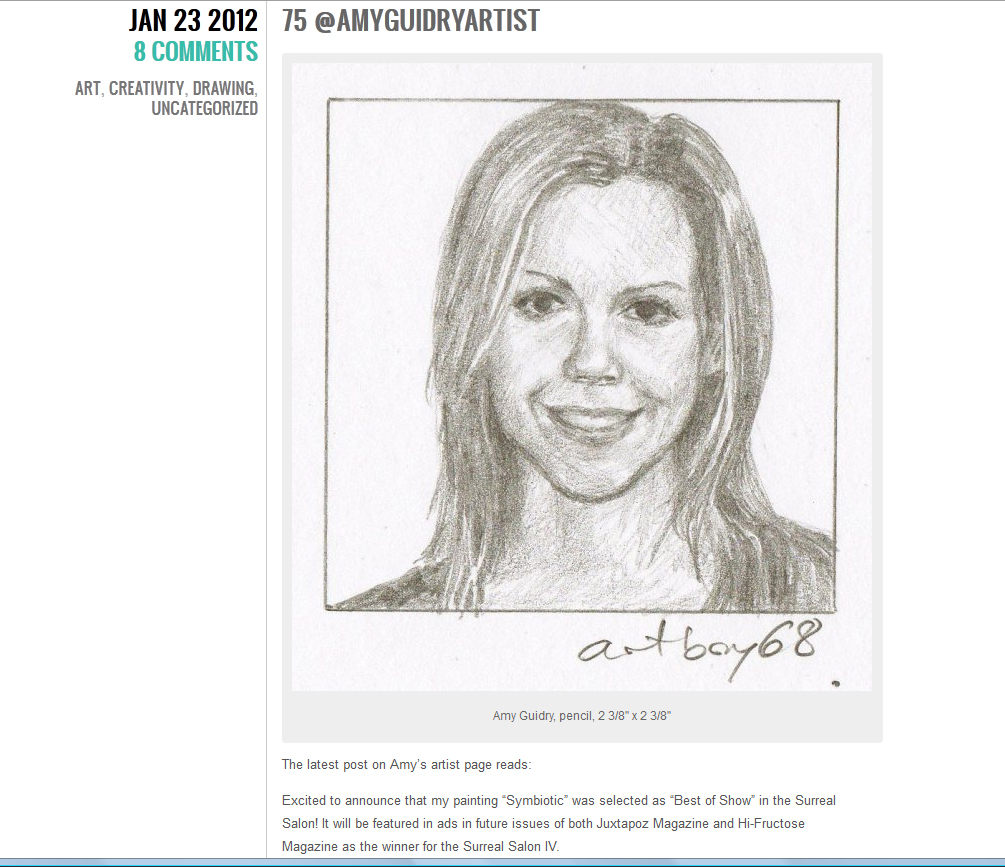
Artist Scott Hamilton's (Artboy68) miniature portrait of me

I found out yesterday that artist Scott Hamilton (aka Artboy68) had completed a miniature portrait of me as part of his project to complete 100 portraits in 20 weeks.  Not only does it look like me, but it’s only 2 3/8 inches square!  I work small, but not that small!  And he did this just by using my Gravatar image (which you can see just about everywhere on this site).  Amazing…  Perhaps he works under a microscope?  I’ve included a screen grab but be sure to check out the portrait (it’s #75) as well as the rest of his work here: http://artboy68project.wordpress.com/2012/01/23/75-amyguidryartist/.  BTW, he already has plenty of subjects to reach 100, however, you can still enter to win a larger acrylic painting as number 100!


Best of Show

"Symbiotic" by Amy Guidry; acrylic on canvas; 11"w x 14"h; (c) Amy Guidry 2010

I had a nice surprise this weekend when I found out my painting Symbiotic received “Best of Show” in the Surreal Salon IV.  As a result, Symbiotic will be featured in ads in future issues of both Juxtapoz and Hi-Fructose magazine as the winner of the Surreal Salon.  I was excited just to have been accepted into the exhibit since these types of competitions receive hundreds of entries from all over the country.  The fact that two of the paintings I entered were selected was big for me, so winning the Best of Show award is beyond words.  It means a lot, especially in such a subjective field, and if I were a writer perhaps I could better explain this, but those of you who are artists know what I mean.  If you have not seen the show, there is still time as it will be up through the 26th (Thursday!) at the Baton Rouge Gallery – Center for Contemporary Art in Baton Rouge, LA.  Both my paintings The Pack and Symbiotic are featured and can be found on my website at www.amyguidry.com/symbiotic.html as well as in the online catalog of the entire show at http://issuu.com/batonrougegallery/docs/surrealsalon4.

————

www.AmyGuidry.com

Sign up for my monthly newsletter at: www.amyguidry.com/contact.html

Follow me on Facebook: www.facebook.com/pages/Amy-Guidry/51953219932

Signing the Dotted Line

A recent online discussion regarding gallery contracts reminded me that this is something I should have posted awhile back.  There are surprisingly a lot of artists that avoid showing with galleries for fear of the contract.  In actuality, the contract is what keeps you protected and prevents anyone from running off with your money.  In fact, if there is a gallery you are interested in working with that does not “do contracts,” you should either make your own for them to sign or else leave.  It’s wise for both parties to have a legally binding document that ensures that everyone involved is covered.  Art is money, so when you’re handing over your work to a gallery, you’re essentially handing them hundreds to thousands of dollars and hoping they’ll take care of it for you.  With that said, here is a list of most (I may be forgetting some things…) of the issues that should be covered in your contract.  Most of these pertain to a gallery that is representing you, but much of this applies to short-term gallery exhibitions as well.

Commission: The standard here is 50/50, but can vary depending on your location.  This absolutely must be covered in any contract with any gallery, no matter if they represent you or not since this is what determines exactly how much you receive from the sale of your work.  And on a side note, it is perfectly fair for a gallery to get half of the sale since they are the ones that have to pay for your exhibition, advertising, rent and utilities for the building, catering, etc.  If a gallery isn’t doing this for you, then they are not earning their share, which in that case, I would recommend going elsewhere.

Payment: Another must.  When will payment be made?  Some galleries may wait until the end of an exhibit to send you your check, while others may pay you immediately.  Sometimes this is determined by how the customer paid, especially if they are on an installment plan.  Usually to cover all bases, contracts will state that payment is made within 30 days from the end of an exhibition.  Just so long as it clearly states that you are going to get paid within a reasonable period of time, then it should be fine.

Insurance: This is another must in my book, however, I have seen some great spaces not offer insurance, so I can’t say that I haven’t taken a risk at times myself.  However, you should be seeking out galleries that provide insurance while your work is on their premises, especially if they are representing you.  If your work is there long-term, odds are greater that something may happen- fire, theft, etc.  You can look into getting your own insurance coverage, but it won’t be cheap, so you may be better off leaving it up to the gallery.

Framing: Frames are not generally required for all artwork, but this should be laid out in the contract.  If frames are required, it needs to be clearly stated who covers this cost and what type of work- drawings, paintings, printmaking, etc. or just certain types of work?

Discounts: It is not uncommon for a gallery to offer discounts to their regulars or for a purchase of multiples.  This practice is normally only done in representing galleries as they are the ones with a particular roster of artists that they deal with on a regular basis.  Discounts can range from 10 to 20%.  The contract should clearly cover what the discount is or what the range may be and how it is divided- evenly between the gallery and artist or does the gallery take that out of their cut entirely?

Shipping: For those that are out of the area or state, shipping costs need to be covered as this can be very costly.  Shipping policies vary among galleries, so I can’t say that there really is a standard here other than that if it is a short-term exhibition in a non-representing gallery, typically the artist pays for shipping their work to and from the gallery.  For a representing gallery, the artist may be responsible for to and from shipping, or only shipping the work to the gallery, or the gallery may cover all shipping costs.  As far as shipping the work to a client, the gallery will either pay or the client will, not the artist.

Outside Sales: This could be a post in and of itself given the discussions with other artists.  The gallery that you work with may allow you to sell work on your own through festivals, studio, etc. and I have yet to see a gallery that doesn’t.  First, be sure that your work is priced consistently with that of the gallery.  Typically if a sale is made to a client from the gallery, then the gallery will get a commission, usually their standard rate.  However, if the client is someone not affiliated with the gallery and did not see your work via the gallery, then the gallery may only require 20 or 30% or often times, there is no commission.  Point being, if you had to do all the leg-work to get that client, then you would get the entire amount of the sale, but again, that would apply to people unaware of the gallery.  This should be covered in your contract, including the commission rate, if any.

Exclusivity: Typically galleries only require exclusivity to the city they are in.  However, some require exclusivity to the region, state, and even the entire nation (though these are generally “blue-chip” galleries dealing with work that goes for hundreds of thousands to millions of dollars).  Again, this is another issue that should be clearly spelled out in your contract.

Loaning Work: This is usually only an issue for those represented by more than one gallery or those that enter work to juried shows in which the same work is already in a gallery.  If work needs to go from one show to another, the gallery that currently represents that work may require a commission if that work sells in another gallery.  Both galleries would get a commission, for example, each gallery may get 30% while the artist gets 40%.  This rate varies among galleries, though, and should be clearly stated.

Length of Contract: Most contracts remain active so long as the artist is with the gallery.  Generally there is an “out” for each party with a 30-days prior notice, again, this may vary, but 30 days is usually all that is required.  In the event that the relationship is not working, either party has the option to end it.

Exhibitions: This only pertains to representing galleries in which your work is there long-term.  What type of exhibitions will the gallery guarantee and how often?  Will you have the opportunity to have a solo exhibition and will you also be given group exhibition opportunities?  Where will your work be when it’s not being exhibited- typically galleries have a salon in which a mix of works by the gallery’s artists are featured in the back room or even in their project space.

Most importantly, take your time and look over your contract before signing.  There’s nothing wrong with asking to have a day or two to look it over.  You could even run it by someone you trust just to make sure there’s nothing you’re missing.  As I said, if a gallery doesn’t have a contract, tell them you would like to make your own and be sure to cover all of these aspects mentioned.  If you’re uncomfortable telling a gallery you want to make a contract, just put it in benign terms such as that it’s how you keep track of things, or that you might forget (not that you want to appear stupid to these people but put it off on yourself if you need a cover).  If you feel any amendments need to be made, write it up and send a proposal to the gallery.  More than likely they will oblige and add it to your contract.  Above all else, if you are not comfortable with the arrangements, do not sign and look somewhere else.  There are plenty of other fish in the sea.

———-

www.AmyGuidry.com

Sign up for my monthly newsletter at: www.amyguidry.com/contact.html

Follow me on Facebook: www.facebook.com/pages/Amy-Guidry/51953219932
Secret Still

Secret Still feature: Amy Guidry

I received a great little review by Brad Martin of Secret Still the other day.  My painting Untitled (Heads) is featured (as seen in the screen grab on the left).  I was flattered that Josh Keyes came to mind when he viewed my work, as I am a fan of his as well.  You can read his flattering- and humorous- review at http://www.secretstill.com/blog/2012/01/11/amy-guidry/.

————–

www.AmyGuidry.com

Sign up for my monthly newsletter at: www.amyguidry.com/contact.html

Follow me on Facebook: www.facebook.com/pages/Amy-Guidry/51953219932