All posts by Amy Guidry

Goals

One of the awards I won early in my career for my painting "Mike"

Goals- simple title, and seems like such a simple concept, but there’s so much more there that most people don’t realize.  We take them for granted, even I do sometimes despite myself.  I was at a reception the other day for a fellow artist and started talking about how I made my goals and strategized in order to become a full-time artist.  One person in the conversation said that I should look into giving courses on goal attainment because it’s a “big” business.  That latter part may be true, but I will stick with my art.  However, I thought it would be a great post to help out those in the arts, whether they are new or old to it.  So here goes:

– First, make a list of the goals you’d like to achieve.  Brainstorm and write down any and all goals.  This can apply to all areas of your life, but let’s stick with your art career.  Write whatever you want to achieve, desire, dream, etc.

– Cull from that list the things that are more attainable given your career at this given time.  This will be your list of goals for the year.  I like to have two lists, so that one is more “now” and the other is for “later.”  Reason being, it may not be feasible to get your work in the Louvre within a year.

– Put your goal list somewhere visible- maybe on your studio wall?  You might even want to make copies of it and put them elsewhere- on the fridge, in your car, your wallet, etc.  Sounds silly, but it will keep these ideas in your mind and help you stay on target.

– Now come up with your strategy.  On a different piece of paper or your computer, etc., come up with a strategy(ies) to attaining your goals.  What are the steps you need to take in order to accomplish goal 1, goal 2, etc.?  Be specific.

– Be flexible.  You may come upon the end of the year and find that not all of your goals were reached or maybe they weren’t what you expected.  Maybe you took all the steps needed and the goal didn’t pan out.  It happens.  So what can you do about it?  Look at what has worked for you and what hasn’t.  Get rid of the goals that aren’t the best use of your time and energy and focus on what does work.  Make changes or alter your strategies in order to meet goals the second time around.  And continue to meet goals that do work well for you.  For example, if showing in a particular city has resulted in good sales, you should plan to show there again next year, or maybe more often.

– Prioritize your goals.  You may need to accomplish one goal before you can realistically meet another.  Or you may find an urgency in accomplishing a particular goal before others.

– Revisit your goals often.  Aside from marking off goals as you reach them, you should be reviewing your goals list every few months to stay on track.  Bigger decisions such as what worked or didn’t work for your career should be left to the end of the year for a better analysis.

– After analyzing your goals at the end of the year, make your new list for the new year with your accomplishments in mind.  Continue to do the things that work.  Include goals that were not reached and devise a new strategy to meet them.  Remove goals that turned out to not be such a good idea.  And, of course, add new goals that you should tackle.

Seems like such a simple concept and many of you may find this silly or unnecessary, but holding yourself accountable is the only way to accomplish something.  You’d be amazed how 15 years can go by without making any real progression in your career, if you do the same thing day in and day out.

www.AmyGuidry.com

Take the Poll

I was inspired to post a poll question on Facebook after a few recent requests for prints.  As of now, I do not have prints available and have always been iffy on the subject.  The inquiries and sales of my work have all been original paintings, which is my own personal preference since I have an art collection myself.  However, I have to ask:

What do you prefer to own?  A large print (let’s say 11″ x 14″) or a small painting (we’ll use my paintings as an example, the smallest being 5″ x 5″)?  Or would you rather save for a large painting you’ve had your eye on?  I’d love to get as much feedback as possible to get a more accurate account.

Vote on your answer here- Facebook poll.

“My Moleskine” magazine

Artist Amy Guidry with her painting, "Trophy," at the Louisiana State Museum

I recently did an interview with Michael Rakov for the Russian arts magazine, “My Moleskine.”  I’m happy to announce that the interview is now online- in Russian, of course- http://www.mymoleskine.ru/2011/08/okorok-ili-grudinka/.  I can say that trying translations through Google and Yahoo Babel Fish produced different results, each being a bit off.  So, I do have the original interview in English to post here (minus the introduction written by Mr. Rakov, since I don’t have that in English):

1.    How did you start making art? Maybe there are any funny stories that were associated with it? Tell us about it.
I started drawing as soon as I could hold a crayon.  On occasion I would be allowed to use more “advanced” (which also meant messy) art supplies such as oil pastels.  I was fascinated by their richness and the colors produced.  I would draw all the time and literally produced so many drawings my mother had to throw some of them out.  I would go through an entire package of typing paper in a week.  As I got older, I was interested in other media such as graphite, pen and ink, and charcoal.  My work became more detailed so I utilized more pen and ink and sometimes charcoal pencils since they allowed for more precision than sticks of charcoal.
As a child, I was always creating through various means, so it was something that came to me naturally.  I knew even at a young age that I wanted to be an artist professionally one day.  I was about eight years old when I decided that my “job” would be to paint for museums, not realizing that museums do not actually pay you to paint all day and then just stick your work on their walls.  By the time I was in college, I decided that I needed to study graphic design and work in the more commercial realm of art.  I, like many artists, believed that it was impossible to earn a living as an artist unless you worked in the design field.  I did this for over eleven years, but eventually I could not deny my initial desire to paint.  I started reading anything I could find regarding running a business, marketing, sales, etc.  I devised a plan to reach my goals and followed a timeline to keep myself on target which is how I became a full-time artist.  I think about art constantly- from the moment I wake up until I go to sleep- I think of paintings that I’m working on, or paintings that I will do in the future, or I’m thinking about exhibitions I have coming up.  It’s a lot of work, but I love what I do.

2.    What is the basic idea in your works? May be there is philosophy or anything like that? For example, Impressionists wanted to stop impression of moment this was them basic idea. What do you want to tell people with your work?
I tend to work in series, so that each is a collective body of work pertaining to a particular subject matter.  That being said, each series serves as a platform for tackling social or political issues.  Some series are broad in scope, while others hone in on one issue.  Art is my way of communicating with the world, raising questions, and presenting ideas.  Though I can’t tell people what to do, I hope that my work will at least inspire them or encourage them to reflect on what they can do to help make a difference in the world.

3.    Your creativity looks like Surrealism, Am I right? But Surrealism is play of senses, meanings etc. What meanings do you play with?
Yes, I have been influenced by Surrealism from a very young age.  In addition to art, psychology was another interest of mine so I gravitated to Surrealism quite naturally since it was the grand marriage of the two.  My style has become progressively more surreal, and I am always looking to challenge myself both technically and conceptually.  As a result, with my latest series “In Our Veins,” I have been working with ideas that come from my dreams and free-association exercises, which were both utilized by the original Surrealists.

“In Our Veins” explores the connections between all life forms and the cycle of life through a surreal, psychologically-charged narrative.  Many of the concepts included in the series deal with life and death, survival and the exploitation of other species for one’s own survival, the connections between all life forms, and the delicate balance of nature.  This includes the interdependence of the human race to each other and to the rest of the animal kingdom, as well as the planet itself.  One cannot exist without the other, therefore it is of the utmost importance that we care for each and every living thing.

4.    What day was the most crazy of your life? What were you doing during that day?
Well, if this is art-related, I do have one story.  I was working on a rather complex painting in hopes of including it in an exhibition I had coming up.  The painting took me longer than expected, so the day before I had to bring my work to the gallery, I was still working on it.  As the hours wore on, I started to realize I was going to have to stay up to finish.  I was exhausted, so I drank two Diet Cokes (which I never have caffeine, so these had a strong effect on me) in order to stay awake and paint until 3am.  Then I went to sleep for about four hours, got up and finished the painting a matter of hours before going to the gallery.  Luckily they are acrylic, which dries quickly.  My paintbrushes were in horrible shape by the time I finished.

5.    Do you do sketches?  If you do, What kind of notebooks or special paper do you prefer for that?
I do a lot of thumbnail sketches, which are roughly 1-inch square sketches giving the basic idea of a concept with just a few lines and shapes, no detail.  I tend to do these types of sketches as an idea comes to mind, so some of them are done on scraps of paper, while others are in a journal or a standard sketchbook.  I will sketch on anything in order to remember my ideas at the time.  When I do larger sketches, I like to use newsprint paper because it’s cheap and also tracing paper.  The tracing paper is useful because I sometimes only want to change one thing in my sketch, so I trace what I’ve already drawn, minus the part I want to change.  Then I can compare the two and see what I like best.  Sometimes I may have to draw the same sketch three or four more times because of all the changes.

To learn more (and see more!) visit www.AmyGuidry.com

NOLA Bound

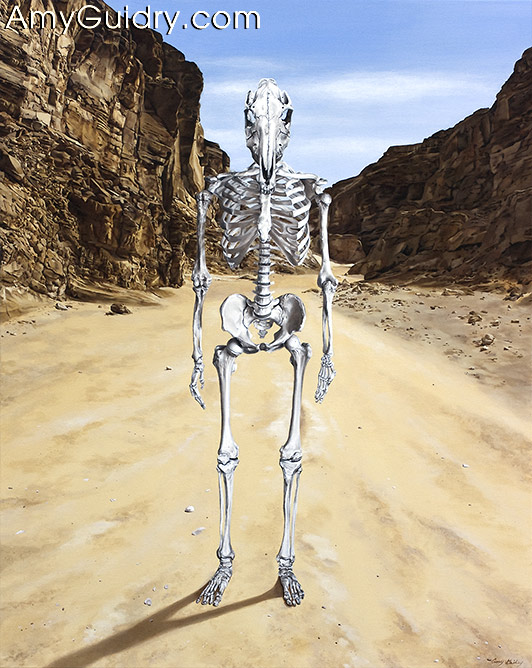
"The Wild West" by Amy Guidry; acrylic on canvas; 24"w x 30"h; (c) Amy Guidry 2011

I have a new exhibition coming up in just a couple of weeks!  Some of my latest works from my “In Our Veins” series will be featured in a group exhibit at Barrister’s Gallery in New Orleans.  The exhibit is titled “Artists Who Wish They Were Dead” and will be guest-curated by artist Dan Tague.  I think this will prove to be an interesting show- I’m excited to see the results.  The opening reception will be August 13th from 6-9pm in conjunction with the Second Saturday Artwalk held in the New Orleans St. Claude Arts District (SCAD).

For more information or images, visit www.AmyGuidry.com

CALYX Journal- Summer Edition is Out!

CALYX Journal 26:3, featuring "Adaptation" by Amy Guidry

I had a delightful surprise arrive in the mail the other day.  My copies of the CALYX Journal featuring my work on the cover arrived!  I’m honored to be the cover artist for their 35th Anniversary- Special Expanded edition, and not only that, but my work is on the inside as well.  My painting “Adaptation” is on the cover and “Freedom” is on page 65.  Both paintings are from my “New Realm” series which is a modern and surreal spin on fairytales in which the woman is the heroine, not the victim.

The CALYX Journal is comprised of art and literature by women, including poetry, photography, paintings, short stories, essays, and reviews.  They were also the first in the U.S. to publish Frida Kahlo’s (one of my Surrealist heroes) works in color.

The Summer edition, Volume 26 Number 3 featuring is available now online at www.calyxpress.org/journal.html.

And for more information on my work, as well as other paintings, visit www.AmyGuidry.com.


What’s It Worth?

Recently on a trip to Baton Rouge, I came across a certain magazine, which happened to have their Art Issue out.  So of course I picked it up, although I found something a bit bothersome in it.  They conducted a little poll of sorts in which they asked “What would it take for you to buy a piece of art?”  Now, only 3 people were featured, but apparently not one of them even own art to begin with, though one at least said she’s “in the market.”  The other two, however, had some pretty appalling answers.  One said that money is the issue and considers art a “superfluous expense.”  Ouch.  Way to use that word-a-day calendar, buddy, but really?  Superfluous?  Do you really consider art to be unnecessary?  The next appalling response said that it would require “getting the artist to come down on the price” and that her artist friend sells work “for like $1000.”  I have to ask how much do you earn for 2 weeks or more of work?  (And 2 weeks is nothing, by the way, most artists, including myself, pour a month into a piece and that’s full-time.)  Cut that $1000 in half after the gallery gets their cut, and the artist is not even making minimum wage.  Now imagine if that was your paycheck- suddenly $1000 isn’t so much.

Okay, my point here is not to lambaste these folks, but to dispel some -unfortunatley- common misperceptions.  When considering the worth of a work of art, so many people forget that hours, weeks, months, sometimes years have been sacrificed to create art.  And I do mean sacrificed because so many artists put this amount of time into their work after already putting in a full day at another job, and they have families to care for, not to mention giving up time to themselves, and working during weekends, holidays, and vacation time.  And even if there isn’t a gallery involved, $1000 for example, is a small price to pay for that person’s efforts.  Not to mention, this is a one-of-a-kind, original work of art.  There will never be another.  It’s not manufactured in China, it’s not mass-produced, and you’ll never find another one like it.  People pay FAR more for clothes, purses, cars, televisions, computers, etc. when those items ARE mass-produced.  I don’t get it.

As for being superfluous, well, I certainly hope that is not the majority’s opinion… I find that comment disturbing regardless of the fact that I’m an artist.  We are visual creatures- we can’t help but marvel at the sight of a rainbow, or find enjoyment at looking at photos of people, places, things, we birdwatch, peoplewatch, and even stylewatch.  Imagine if the world around you had been replaced by stark walls and concrete.  No more pictures on your walls.  Your clothes have been replaced with the same drab uniform.  What if color no longer existed?  Or patterns?  No shapes, no lines, just void areas of space.  I can guarantee you would become bored and even depressed.  Just at its most basic level, art affects our moods, uplifts us, speaks to us.  Go a little deeper and add a narrative to that art and it can make us laugh, cry, reminisce, and that’s just the tip of the iceberg.  We need art just as much as we need music, literature, and theater.  We enjoy them.  We connect with them.  They help us to understand this crazy world a little better and make it a little more pleasant along the way.  I say that is most certainly a necessity.


Jurors’ Choice Award

I recently attended the Preview Party and Awards Presentation for the 2011 Art Melt at the Louisiana State Museum in Baton Rouge, LA.  During the presentation, I was pleasantly surprised to see that as the very first award was presented, my painting “Trophy” suddenly flashed upon the screen.  I received the Jurors’ Choice Award in which juror Kelli Scott Kelley gave a talk about my work.  It was an honor just to be selected for the exhibition since these things can be tough to get into given the hundreds, sometimes thousands of entries juried competitions typically receive.  So imagine my surprise when my work was announced for an award.  And it gets better!  Later on, I was called upon again for an Honorable Mention (which, again, I am honored, though I am surprised that a work can receive more than one award).  All in all, it was a fun event and a great exhibit.  And even if you missed the opening, the show will be up through August 28th so there is still plenty of time.

Also of note- this is the first year that Art Melt is offering an exhibition catalogue.  The catalogue as well as the actual artwork are all available for purchase online at this link:  https://forum35.site-ym.com/store/view_product.asp?id=811134

To view more photos, visit www.AmyGuidry.com/events.html.

Rivers Opening Reception

I recently attended the opening reception for Rivers at Wally Workman Gallery in Austin, TX.  My painting “Synergy” is featured in the group exhibition as well as many other works by the gallery’s represented artists.  I’ve posted a few photos from the event, but you can view the entire album at www.AmyGuidry.com/events.html.

Gallery Opportunities

Viewers at Gallery 549 looking at Amy Guidry's paintings

With two group shows less than a week apart, another in the next month, and a solo show only 7 months away, a lot of pe0ple think I’m really busy.  Or uber-busy.  It seems normal to me, though, especially if I want to maintain a career as an artist.  So this has me thinking that this must not be the norm, which is unfortunate because I like to think that artists are all showing their work somewhere other than their basement.  So I have to ask- are you doing all that you can to promote your work?  Or do you not know where to start?  For those that are beginners, I thought I’d take this opportunity to discuss how to exhibit your art.  And maybe even those of you who are not new to this will pick up some ideas.

First, I like to ignore all the “rules” regarding getting into galleries.  So many people say you should start small and local.  Yes, there is some truth to this, but don’t sell yourself short.  Some of my very first exhibitions were out of my city and out of my state, so there goes that rule.  Secondly, there are a lot of people that say you shouldn’t even approach a gallery, that you should just let them call you.  What??  If I want something, I don’t just sit on my couch and will it to me.  I go out and get it.  Now, don’t get me wrong, that doesn’t mean you can just march into a gallery and dump your portfolio in their lap.  You should send them your work in a professional manner- read my steps for doing this in a previous post.

Galleries like to know that you are going to be reliable and not flake out if they book a show with you for several months/years in advance, hence the need for a good resume.  So you’ll need to build your exhibition history.  But how do you get an exhibit if you have never exhibited before?  I know- it’s like which came first, the chicken or the egg.  This is where starting small and local comes in since you’re more likely to get into a gallery that knows you personally through local events, plus if they are not solely looking for established artists, you’ll have a better chance.  That said, don’t limit yourself, either.  There’s no harm in trying to get shows elsewhere- especially group exhibitions since galleries know that if you drop out, it won’t be so hard to replace you or make up for it.

In addition to galleries, there are other ways to exhibit your work.  I’d recommend this whether you need to build your exhibition history or even if you’ve done hundreds of shows.  You can never reach enough people.

University galleries and museums– great to have on your resume, but won’t result in sales necessarily because the general public doesn’t think to go there to buy art.  That’s just the perception they have.  However, these venues are very prestigious and build your credibility among collectors and galleries.  You will need a few shows under your belt to score one of these, but just to say, this is something you should be aiming for.

Local museums– more likely to show your work these days due to the economic crisis.  Their funding has been limited since the government loves to cut arts funding first, so they can’t afford to ship work and give stipends to national/international artists.  So get to know your local museum and send them a proposal.

Juried exhibitions– Now there is a lot of debate over these types of shows since some think they lead to nothing, while others think you should never pass an opportunity to exhibit.  If you are completely new to exhibiting your work, I say go with the latter.  When you’re starting out, you won’t discriminate so much- there’s plenty of time to do that later once you’ve been showing a lot.  If you’ve built a bit of an exhibition history, that’s a different story.  Personally, I will do juried exhibits, but that’s only if I feel they are worthwhile.  I decide based on:
Where the show is being held– is it a good venue or is it some cube in the middle of nowhere?
Who is the juror– someone prestigious in the art world or just somebody’s grandma that took a watercolor class once?
Is the venue insured? Nevermind whether your own work is insured, if the venue itself can’t afford insurance, then it’s probably not a good one (sorry).
What city/state/country is the venue located– again, don’t go with someplace not typically known for art.
Is it a vanity gallery? There are a few of those out there holding juried shows- make sure the gallery has a good reputation.

Lastly, look into exhibition opportunities that are off the beaten path.
Pop-up galleries are the latest “it” spaces and do not require representation, so you are more likely to get into one.  Also, if you are just starting out, look into showing at coffee shops, bookstores, libraries, bank lobbies, doctors’ offices, law firms, gift shops, restaurants, etc.  Although food and smoke near your work is a scary concept, so just consider that risk, but look into making your own exhibits through these venues.  Not all will lead to sales, which is why many don’t bother, but it will build your name in the community, build your exhibition history (until you can gain more via galleries, etc.), and it can lead to future sales since people will see your work and talk about it with others well after your show.  Each step builds upon the other.  It all takes time- Rome wasn’t built in a day.

I’m sure I’m forgetting some things, so if you have ideas for opportunities to share, please feel free to add them in the comments section.

www.AmyGuidry.com

Visionary Artistry Mag

Visionary Artistry Mag feature "Amy Guidry: Inspired by Nature"

I’m excited to announce a new feature on my work!  Morgan King of Visionary Artistry Mag did a feature, very thorough at that, on my art.  There’s a mix of paintings featured including some of my most recent work from my “In Our Veins” series.  To read the article, visit this link: http://visionaryartistrymag.com/2011/07/amy-guidry-inspired-by-nature/.

www.AmyGuidry.com