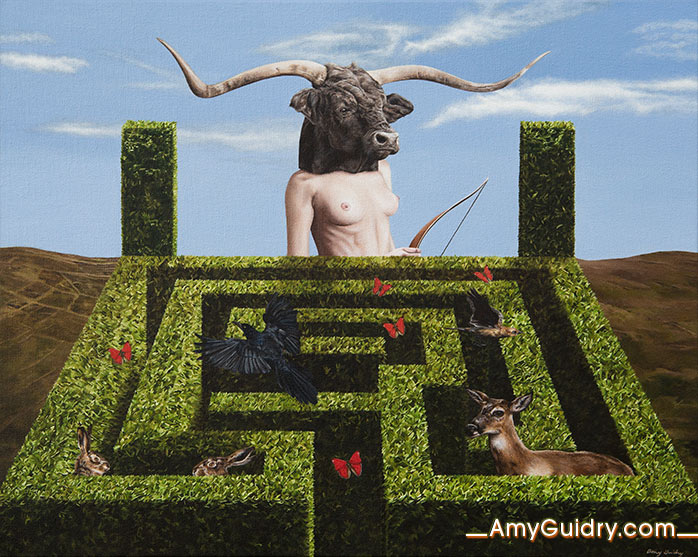
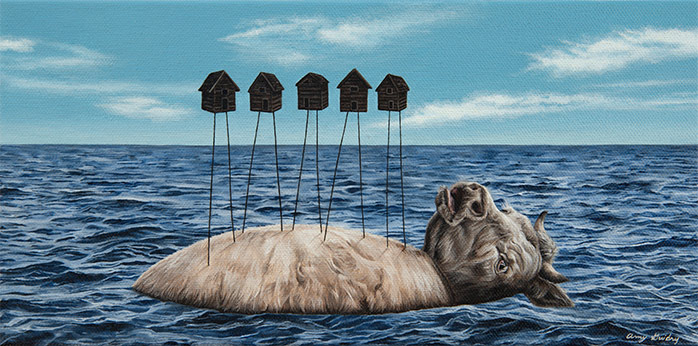
“Lightness” by Amy Guidry; Acrylic on canvas; 24″w x 48″h; SOLD; (c) Amy Guidry 2014
“Complete” by Amy Guidry; Acrylic on canvas; 30″w x 40″h; SOLD; (c) Amy Guidry 2014
Two paintings from my New Realm series have found new homes. Lightness is an acrylic on canvas, 24″ wide by 48″ high. Complete is also an acrylic on canvas, 30″ wide by 40″ high. Both paintings can be viewed online (as well as the rest of the series) here: http://amyguidry.com/lightness.html and here: http://amyguidry.com/complete.html.
“Bon Appetit” by Amy Guidry; Acrylic on canvas; 30″w x 40″h; SOLD; (c) Amy Guidry 2014
A painting from one of my earlier series, Beneath the Surface, has found a new home. This piece is titled Bon Appetit and is an acrylic on canvas, 30″ wide by 40″ high. Much of this series has sold but there are a few still available. View Bon Appetit and the remaining paintings online here: http://amyguidry.com/bon_appetit.html.
Installation of “Sequence” by Amy Guidry; Acrylic on canvas; 6″w x 12″h; SOLD; (c) Amy Guidry 2014
When it comes to hanging art on my wall, I personally like to just go with what looks right to me. Then again, I am an artist so that may be a little easier to do than for others. So with that in mind, I’ve found a few short, visual, and helpful articles online to give you some help on how to hang your art, where to hang it, how to arrange it with other art, and how to light it. The visuals alone are great ideas.
“Dichotomy” by Amy Guidry; Acrylic on canvs; 20″w x 16″h; (c) Amy Guidry 2014
I’ve recently finished my latest painting in the In Our Veins series. You may recall seeing my progress photos posted here along the way. The title is Dichotomy and it is an acrylic on canvas, 20″ wide by 16″ high. View the painting online (larger and with a zoom feature as well) here: http://amyguidry.com/dichotomy.html.
“The Pack” by Amy Guidry; acrylic on canvas; 20″w x 10″h; (c) Amy Guidry 2014
I recently received some good news! My work has been selected for inclusion in the B14- Wiregrass Museum of Art’s 2014 Biennial. The exhibition will open in July, with an opening reception on July 17th at 5:30 pm. The exhibition will remain up through September at the Wiregrass Museum of Art in Dothan, Alabama. More details soon.
“Parting” by Amy Guidry; Acrylic on canvas; 4″ x 4″; SOLD; (c) Amy Guidry 2014
“Resilient” by Amy Guidry; Acrylic on canvas; 6″w x 4″h; SOLD; (c) Amy Guidry 2016
I’ve just added a couple of new paintings to my In Our Veins series online. Both are featured in my recent newsletter. Parting is an acrylic on canvas, 4″ x 4.” Resilient is also an acrylic on canvas, 6″ wide by 4″ high. View the paintings online here http://amyguidry.com/parting.html and here: http://amyguidry.com/resilient.html.
Occasionally I get asked if I ship my work, which is a common question among artists and non-artists alike. The thought of packaging an original work of art and handing it over to a carrier is scary. I will admit that it makes me anxious. However, after reviewing the methods of other shipping companies, as well as researching the internet, I have been successfully packaging my own work for transit for many years now. I have to say that this was not only a financial decision, but also based on a bad experience in which one of my paintings was damaged by a shipping company. So here are the steps I follow when shipping my paintings:
– Wrap the front and sides of the canvas with glassine paper. This can be found online at just about any art supply shop. Be sure to tape the paper to the back, not the front of the canvas.
– Then wrap the painting front and sides with a sheet of mylar. I like Grafix Dura-Lar which you can find on Utrecht.com. This helps protect against moisture due to climate/temperature change.
– Bubble wrap the painting with large bubble wrap, covering the back as well. I like to then wrap it again with another sheet of bubble wrap. Try to limit the tape to just along the sides to help prevent someone from cutting into the painting when removing tape.
– Prep your box for transit. I like the ones offered by U-Line (uline.com) since they have boxes specifically for artwork. I suggest getting one that leaves a minimum 3 inches of space around your painting.
– Tape one end of the box together with clear packing tape, covering it horizontally and vertically as well as along the seams of the box and corners.
– While the box is empty, I like to mark it with a permanent marker, writing “Fragile” on all sides of the box and I put an “up” arrow along where the top is. Also, it helps the gallery if you write your name (I just use my last name since it’s unique enough) on the box as well. Just be sure that it is away from the “Fragile” signs to help with visibility.
– Before stuffing the box, I use a few extra sheets of cardboard to protect the body of the box and the painting. I like to have 2 sheets on either side of the painting, but if it’s really thick you can use one on each side. The cardboard should be cut to cover the painting but be just smaller than the inside of the box to ensure a good fit.
– When shipping a larger painting, I like to use a couple of sheets of thin wood such as luan, which I get at Home Depot. I will also add a couple of sheets of cardboard as well, if space allows.
– Line the bottom of your box with crumpled brown kraft paper or tissue paper. I advise against colored tissue paper or newspaper in case of bleeding. Pack the bottom well, especially the corners of the box.
– Place the wrapped painting in the box, between the sheets of cardboard so there are even amounts on each side. If using luan, place the painting between the luan, leaving extra cardboard evenly on each side.
– Line the sides of the box with more kraft paper or tissue paper. If the box is large, you may need a dowel or broomstick to help push the paper down the sides to ensure they are properly stuffed.
– Finish with kraft paper or tissue across the top of the painting. If including a gallery contract or other paperwork, I put that information in a 9×12 envelope and place it across the top of the painting before adding kraft paper. Then seal with clear packing tape, again going horizontally and vertically.
In cases where the work will be shipped back to me, I like to include a typed packing instruction sheet for the gallerist. Make sure your name, contact info, and the name of your painting is on the sheet as well. This way you can ensure that your painting is packaged in the same manner as it was received.
Also, I won’t promote any one carrier, but I will say that I prefer 2-day Air shipping. It can be expensive depending on the size of the piece, but it goes through the least number of hands. (Other than overnight, which is $$.)