Tag Archives: Painting

New Work


I’ve just added two new paintings to my In Our Veins series.  The first is Synthesis, an acrylic on canvas, 4″ x 4.”  The next painting is Division, also an acrylic on canvas, 4″ x 4.”  Synthesis has just sold and currently on its way to its new home but Division is currently available.  I have more new paintings to feature as well, including the piece I posted in progress earlier in the month, so be on the lookout.  In the meantime, I have the current new work posted on my Facebook Fan Page which you can view here: http://www.facebook.com/pages/Amy-Guidry/51953219932?sk=photos_stream.

————

www.AmyGuidry.com

Sign up for my monthly newsletter at: www.amyguidry.com/contact.html

Follow me on Facebook: www.facebook.com/pages/Amy-Guidry/51953219932

Before and After

My tiny brushes- before and after

I get asked pretty often how I paint such small details.  I always tell people that I use small paintbrushes and work on one square inch area at a time, but I don’t think that really quite explains it.  Sometimes a picture is worth a thousand words so I thought I should take a before and after of my brushes.  Now, these are actually in better condition than most since I’ve been working on small paintings lately.  Usually I use these on some larger canvases and those bad boys destroy the bristles.  Regardless, you get the idea.  The new brush is on the right- crisp, pristine and miniscule compared to a dime.  The group on the left are my “afters” with the bristles splayed out in different directions or completely curved which does not work very well for fine details.  I go through roughly a brush a day, sometimes I can eek out two days, depending on the painting.  Now just imagine taking that to a 30 inch tall painting: http://www.amyguidry.com/wild_west.html.

————

www.AmyGuidry.com

Sign up for my monthly newsletter at: www.amyguidry.com/contact.html

Follow me on Facebook: www.facebook.com/pages/Amy-Guidry/51953219932

In Progress

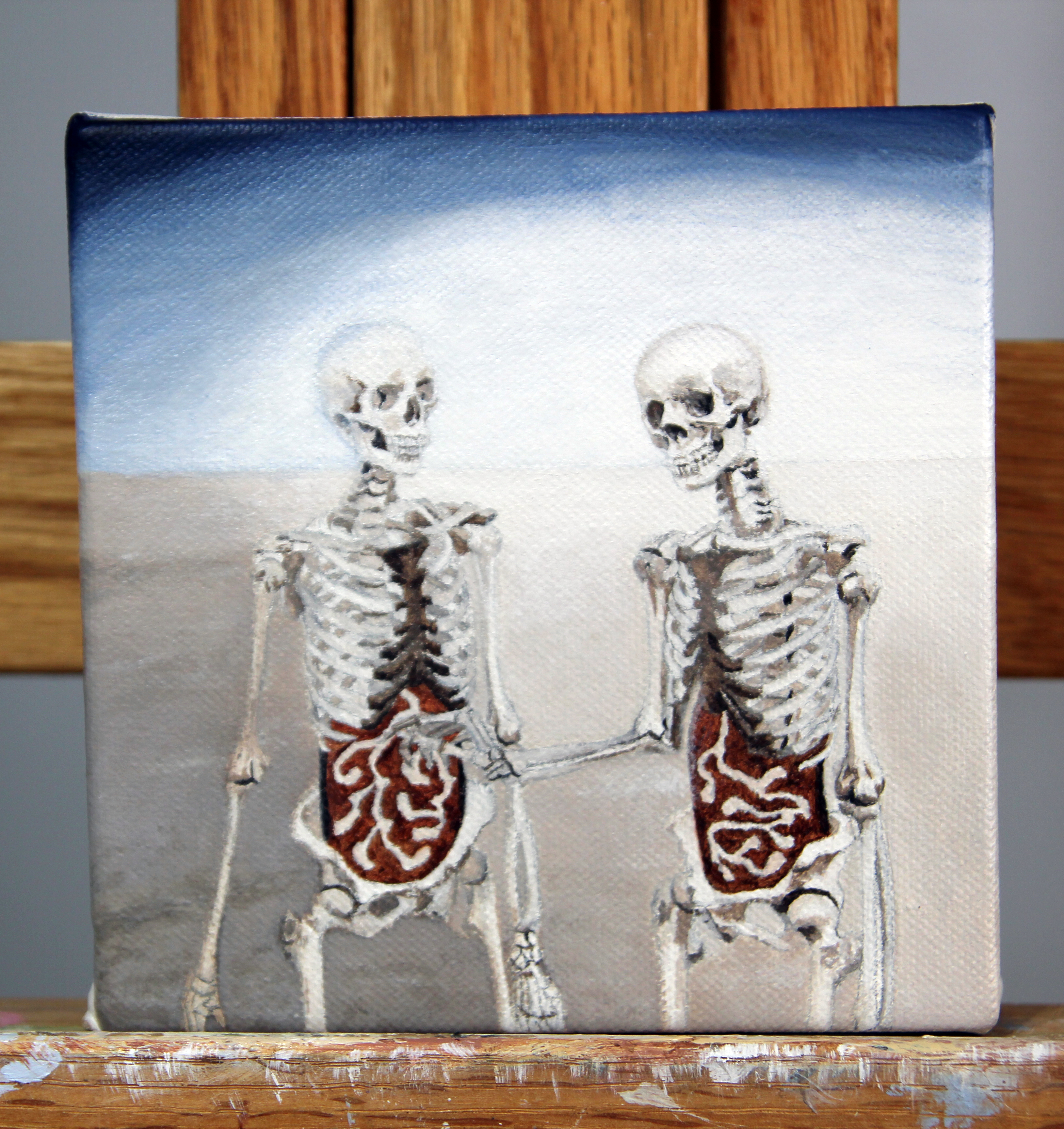
Progress shot of “Systems” by Amy Guidry; acrylic on canvas; 6″ x 6″; 2010-2012; (c) Amy Guidry

I’ve sometimes been asked if I ever work on a painting and decide I don’t like it.  Usually if something is not working out, I’ll find a way to fix it.  Well, I thought I’d share a piece that I almost gave up on until now.  I started this piece- get this- in February of 2010.  It’s been over 2 years and I’m just now touching this one again.  At the time, I found it a bit overwhelming working on the skeletons at such a small size, since this is a 6″ by 6″ canvas.  In addition, I just wasn’t happy with the background and kept changing my mind.  So I put it away.  There were a few times when I thought about just throwing it out and I even started to do a larger version, but that wasn’t right.  The size of canvas I choose is based on the amount of visual information I need to get across.  There is such a thing as too big.  So after some time away, I decided to tackle it one last time.  The photo that you see here is actually where I left off before deciding to work on it again.  I’ll be posting the finished piece soon, so be on the lookout.

————

www.AmyGuidry.com

Sign up for my monthly newsletter at: www.amyguidry.com/contact.html

Follow me on Facebook: www.facebook.com/pages/Amy-Guidry/51953219932

Sold

“Vessel” by Amy Guidry; acrylic on canvas; 4″ x 4″; SOLD; (c) Amy Guidry 2012

Another painting from my In Our Veins series has found a new home.  This piece is titled Vessel and is an acrylic on canvas, 4″ x 4.”  It will soon join one of my other paintings from the same series.  I like working on these small paintings- they work well individually and as well as in a group.  Some people have asked how or even why I work so small- even my larger pieces have a lot of little details.  I never thought much of it- I like to work on detail, simple as that.  It’s fun for me to work on one square inch at a time and then step back and see how it works in the grand scheme of things.  Within those square inches, I’m adding little dabs of paint, which when viewed at such a close range, is really abstract.  It’s my foray into the abstract world.  You can view the series online here: www.amyguidry.com/wild_west.html.

————

www.AmyGuidry.com

Sign up for my monthly newsletter at: www.amyguidry.com/contact.html

Follow me on Facebook: www.facebook.com/pages/Amy-Guidry/51953219932
New Work


I’ve recently added two new paintings to my In Our Veins series.  Transient is an acrylic on canvas, 6″ wide by 4″ high, and Segments is an acrylic on canvas, 4″ wide by 6″ high.  Both paintings tackle our vision of animals as just pieces and parts (ex. head, rump, wing, tongue, breast, etc.).  In Transient, the butterflies exiting the body represent the life that ends when animals are hunted as trophies.  At the same time, the butterflies represent the metamorphosis of one life energy into another.  Segments features a fractured horse while focusing on facial expression and positioning to emphasize the importance of animals.  View closeups of Transient and Segments online here www.amyguidry.com/transient.html and here www.amyguidry.com/segments.html, respectively.

————

www.AmyGuidry.com

Sign up for my monthly newsletter at: www.amyguidry.com/contact.html

Follow me on Facebook: www.facebook.com/pages/Amy-Guidry/51953219932

Prints: An Overview

As some of you may know, I do not offer prints of my work.  I’ve only ever had a handful of people ask me if I make prints of my paintings, so I’ve never felt it was a popular item.  I even took a poll and people were 100% interested in Original Work only.  Many would rather have a small painting than a reproduction.  With that said, I thought it would be useful to give an overview of prints for those of you on the fence about offering prints or if you are looking to purchase a print.

First, the term “print” has become a bit muddied.  I use the term print here because that has become the common understanding, however, print actually comes from the process of printmaking.  Printmaking involves creating an image by etching, drawing, or carving  on various media such as wood, copper, linoleum, stone, fabric, etc. and inking the design before pressing it by hand or through a printing press to transfer the image.  The original work used to create the fine art print is created by the artist and destroyed by the artist afterwards.  Hence, the edition of prints is limited.

Digital prints, reproductions, or giclees are printouts of an existing artwork, usually printed by someone other than the artist, and are never truly limited as anyone can print the image again since it is digital.  (There is no plate to destroy.)  Regardless of the quality of the reproduction, these type of prints do not go up in value as they are not an actual fine art print.  In addition, many of these prints are not even produced with the original work of art present, therefore the colors in the printout will vary from the original.

That being said, I am an artist and having actually studied printmaking as part of my college curriculum, I do have a bias for original art.  However, if you are a fan of Van Gogh, for example, the only way you can feasibly own an image of his work would be through a reproduction.  Be sure to look for high quality, archival materials- meaning they will hold up over time and not fade- when purchasing your prints.  Prints can fade easily not only due to UV exposure, but also humidity, temperature, and even the air.

So next time you are considering a fine art print or a reproduction, here is a glossary of terms to look for:

Aquatint: A process imitating watercolor or wash drawings by etching a microscopic crackle on the copperplate intended for printing.

Artist’s Proof: An early set of prints pulled for the artist’s own use, marked as A.P.  Sometimes (10-30%) higher in value than the regular edition prints.

Drypoint: Engraving technique, especially on copper, in which a needle is used for producing furrows having a burr that is often retained in order to produce a print characterized by soft, velvety black lines.

E.A.: (epreuve d’ artiste) French for Artist’s proof.

Edition: A number of art prints of the same image, all the same size and as close to identical as possible.

Etching: Image created on a metal plate, glass, etc., by the corrosive action of an acid instead of by a burin.

Giclee: Printed artwork or photograph produced by using a high quality digital inkjet printer.

Intaglio: Incised carving, as opposed to carving in relief.

Linoleum Cut (or Linocut): A relief technique using linoleum rather than wood.

Lithography: Image created on a flat, specially prepared stone, with some greasy or oily substance, in which printing ink sticks to the greasy areas.

Mezzotint: A method of engraving on copper or steel by burnishing or scraping away a uniformly roughened surface.

PA: (Prova d’Autore) Italian for Artist’s proof.

Silkscreen (or Serigraph): a printmaking technique in which a mesh cloth is stretched over a wooden frame and the image is painted on the screen or affixed by stencil, and printed by having a squeegee force color through the pores of the material in areas not blocked out by a glue sizing.

Woodcut: Carving into a block of wood in which prints are made from the inked relief areas.

————

www.AmyGuidry.com

Sign up for my monthly newsletter at: www.amyguidry.com/contact.html

Follow me on Facebook: www.facebook.com/pages/Amy-Guidry/51953219932
Artful Vagabond

Artful Vagabond: Interview with Amy Guidry

I was recently interviewed for Serena Kovalosky’s site Artful Vagabond as part of her 365-Day Tribute to Artists and the Creative Mind project.  As stated on her site, the project “is a series of daily online inspirational articles that celebrates the artistic mind and the creative process. Each post is accompanied by artwork from professional artists around the world.”  Check out the post online here: http://www.artfulvagabond.com/the-grand-marriage-of-psychology-and-art-day-284/.

Also of note, fellow vegan artist, Allison Bratt did a wonderful write-up about my work on her blog.  (You may recall I posted about a painting by Alli that I had purchased for my own art collection.)  Read the article here: http://allisonjbratt.com/2012/10/art-spotlight-amy-guidry/.

————

www.AmyGuidry.com

Sign up for my monthly newsletter at: www.amyguidry.com/contact.html

Follow me on Facebook: www.facebook.com/pages/Amy-Guidry/51953219932

Panel Discussion

I wanted to share a few photos from the panel discussion the other day.  Artists from the “Louisiana Voices: Six Artists Speak to Us” exhibition were invited to hold a panel discussion at the Paul & Lulu Hilliard University Art Museum.  Five of the artists were present: Melissa Bonin, Linda Trappey Dautreuil, Troy Dugas, Amy Guidry, and Lisa Osborn.  The exhibition is currently open at the Hilliard now through December 8th, so be sure to check it out while you are in Lafayette.

————

www.AmyGuidry.com

Sign up for my monthly newsletter at: www.amyguidry.com/contact.html

Follow me on Facebook: www.facebook.com/pages/Amy-Guidry/51953219932

Cohabit

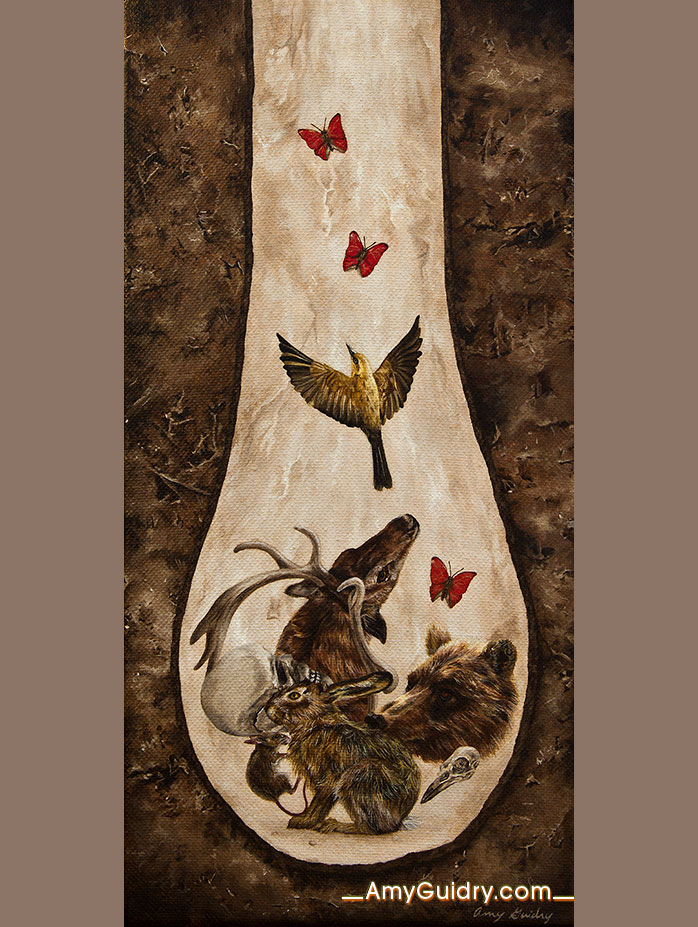
“Cohabit” by Amy Guidry; acrylic on canvas; 6″w x 12’h; SOLD; (c) Amy Guidry 2012

I’ve recently finished another painting in my In Our Veins series.  Cohabit is an acrylic on canvas, 6″ wide by 12″ high.  In keeping with the series, there are various animals and insects, some being just heads or a bust, as well as those that are alive and some that are not, representing the stages of the life cycle.  The cutaway view of the tunnel serves two purposes.  One, it illustrates how various species often share dwellings such as tunnels (which is why destroying animal habitats has such a huge impact on the ecosystem).  And secondly, it is a reminder that organisms underground- both living and not- affect everything living above ground.

View the painting online here: http://www.amyguidry.com/cohabit.html.

————

www.AmyGuidry.com

Sign up for my monthly newsletter at: www.amyguidry.com/contact.html

Follow me on Facebook: www.facebook.com/pages/Amy-Guidry/51953219932